


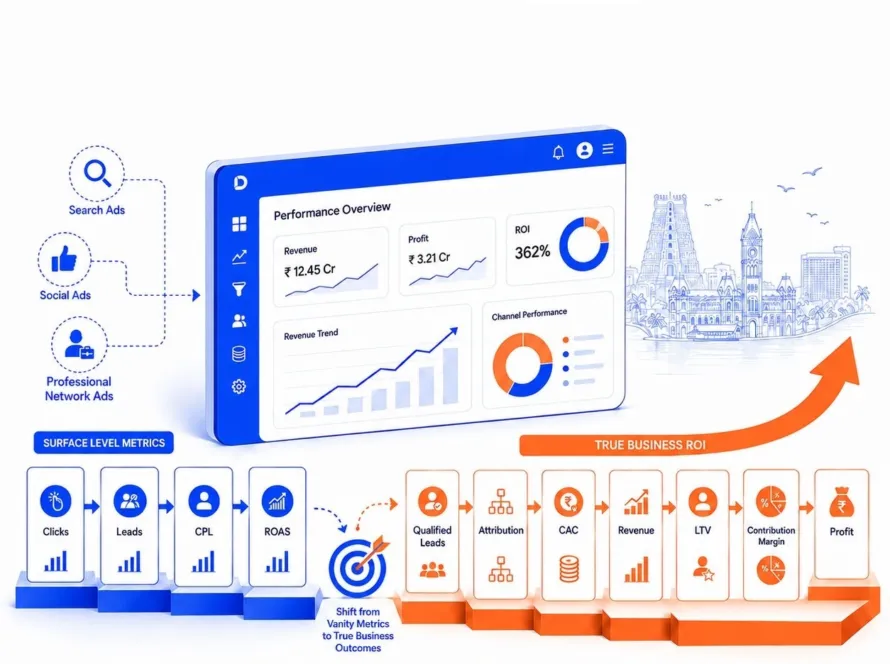
Performance marketing becomes more valuable when advertising data is connected with CRM and revenue outcomes. Ad platforms can show clicks, conversions and cost per lead, but the CRM reveals which leads were valid, qualified or converted, while revenue data shows which campaigns created actual commercial value. Connecting these layers helps businesses optimise toward better customers, improve budget allocation, calculate customer acquisition cost more accurately and scale campaigns based on business outcomes rather than surface-level media metrics.
Most marketing teams already have plenty of data. The problem is that the data often lives in separate rooms and refuses to speak to its neighbours.
Google Ads knows the click. Meta knows the impression and conversion event. The website knows what the visitor did. The CRM knows whether the lead was useful. Finance or ecommerce systems know whether money actually arrived.
When those systems remain disconnected, marketing optimisation stops too early. A campaign can look brilliant because it generated inexpensive leads while sales quietly discovers that most of them never become customers.
Performance marketing tells you what generated the action. Analytics helps tell you whether the action was valuable.
Why Is Ad-Platform Data Alone Not Enough?
Ad platforms are excellent at describing what happened inside or immediately around the advertising interaction. They can show spend, impressions, clicks, conversions, conversion value and many useful diagnostic metrics.
But many businesses make money later in the journey.
A property buyer may submit a lead today and book after several weeks. A B2B prospect may become an opportunity after multiple calls. A student enquiry may convert only after counselling. A retailer may influence an offline store visit that the original campaign cannot see clearly.
If marketing decisions are made only from the first visible conversion, the business risks optimising the beginning of the funnel while ignoring the end.
What Does Connecting Ads, CRM and Revenue Actually Mean?
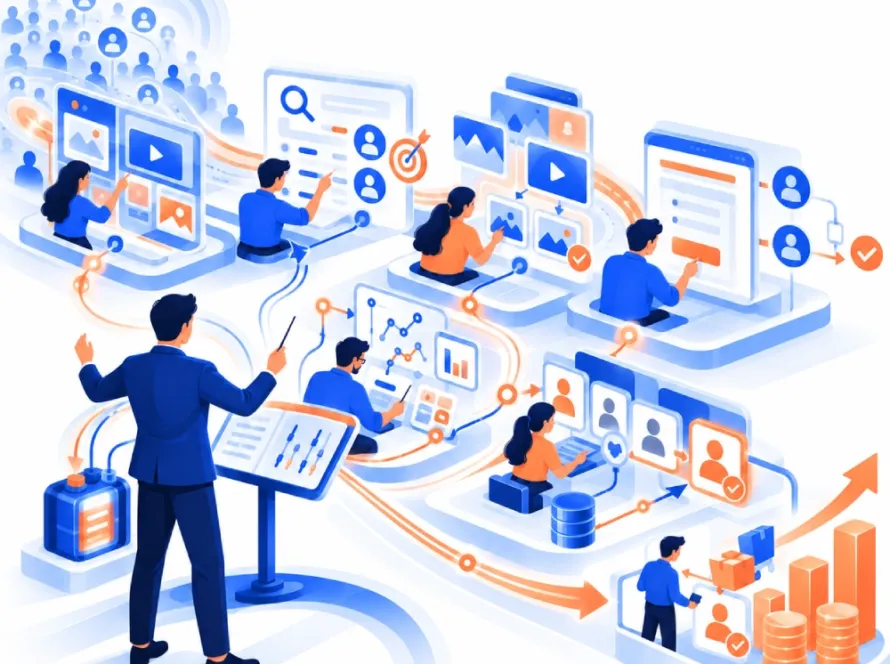
It means creating a measurement chain that follows a prospect from marketing interaction to a meaningful business outcome.
| Layer | What It Adds |
| 1. Advertising | Campaign, channel, audience, keyword, creative, spend and initial conversion. |
| 2. Website / Landing Experience | Page behaviour, form completion, call, message, purchase or other tracked action. |
| 3. CRM / Lead Management | Valid lead, qualified lead, appointment, opportunity, lost reason and sales stage. |
| 4. Revenue / Customer Outcome | Purchase, booking, contract value, revenue, margin or customer lifetime value where available. |
| 5. Analytics / Decision Layer | Compare the journey across campaigns and use the result to change budget, targeting, creative and conversion strategy. |
The exact technology stack will differ by business. The strategic objective is the same: marketing should learn from what happens after the initial conversion.

How Does CRM Data Change Performance Marketing?
CRM data adds a layer that advertising platforms often cannot understand on their own: lead quality.
Suppose Campaign A generates 300 leads at ₹400 each. Campaign B generates 180 leads at ₹650 each. If Campaign A creates 30 qualified leads and Campaign B creates 80, the cheaper CPL has become a very misleading victory.
Once CRM stages are connected to campaign reporting, marketers can compare qualified lead rate, opportunity rate, sales conversion and customer acquisition cost rather than raw lead volume alone.
The CRM turns ‘we generated leads’ into ‘we generated these kinds of leads, and this is what happened to them.’
How Does Revenue Data Improve Budget Decisions?
Revenue data changes the question from ‘Which campaign converted?’ to ‘Which campaign created valuable customers?’
Two campaigns can produce the same number of customers and still have completely different economics if one attracts larger deals, higher-margin products or customers with better repeat behaviour.
This becomes especially useful when the business has multiple products, services, geographies or customer segments.
Instead of distributing budget according to the cheapest conversion, the business can increasingly distribute it according to downstream value.
What Metrics Become More Useful Once the Data Is Connected?
| Metric | Question | Why It Matters |
| Raw CPL / CPA | How efficiently did media produce the initial action? | Useful operational signal, but incomplete. |
| Valid lead rate | How many enquiries were genuine and relevant? | Separates basic quality from raw volume. |
| Qualified CPL | What did a commercially useful lead cost? | Better lead-generation efficiency measure. |
| Lead-to-opportunity rate | How often did marketing create real sales potential? | Connects marketing with pipeline quality. |
| Lead-to-sale rate | How often did enquiries become customers? | Shows downstream effectiveness. |
| CAC | What did it cost to acquire an actual customer? | Core unit-economics metric. |
| Revenue by source | Which campaigns and channels contributed to commercial value? | Improves budget allocation. |
| Contribution / margin | Did the acquired revenue create healthy economics? | Prevents revenue-only optimisation. |
| LTV / repeat value | Do some sources attract more valuable long-term customers? | Supports smarter scaling where relevant. |
How Does This Improve Google Ads and Meta Ads Decisions?
The value of connected data is not the dashboard itself. It is what the marketing team can do differently because of it.
For example, the business may discover that:
- A Google Search campaign has a higher CPL but produces far more sales-qualified leads.
- A Meta audience generates volume but weak downstream conversion.
- One creative angle attracts fewer enquiries but significantly stronger purchase intent.
- A geographic area looks expensive at lead level but produces larger transactions.
- A product category has excellent ROAS but weak margin once fulfilment costs are included.
- A retargeting campaign receives too much credit for customers originally influenced by another channel.
Each of those findings can change bidding, budget, targeting, creative or landing-page decisions.

Why Attribution Still Matters – but Should Not Become a Religion
Connecting data does not create a perfect map of human behaviour.
Customers switch devices, see offline communication, talk to salespeople, revisit websites and sometimes buy for reasons no attribution model can observe.
Attribution is therefore a decision aid, not an oracle.
The useful approach is to combine attribution with conversion-path analysis, CRM outcomes, experiments, incrementality thinking and business context. The objective is not to assign mathematically perfect credit. It is to make better budget decisions than you could with disconnected data.
What Does a Practical Ads-to-Revenue Data Flow Look Like?
A practical system does not need to begin with an enormous data warehouse and twelve engineers.
A sensible progression might be:
- Track key website and campaign conversions reliably.
- Standardise campaign naming and source data.
- Capture marketing source information with leads where appropriate.
- Define CRM stages such as valid, qualified, opportunity and customer.
- Create a regular way to connect downstream outcomes with campaign reporting.
- Build a dashboard or analysis layer that combines spend, leads, quality and revenue.
- Use those insights in weekly or monthly optimisation decisions.
- Automate more of the data flow only after the definitions and decisions are working.
This sequence matters. Automating a badly defined metric simply produces wrong answers more efficiently.
Do You Need a Data Warehouse for This?
Not always.
A smaller business may begin with clean ad-platform tracking, GA4, a CRM and a well-designed reporting layer. As channel count, transaction volume and data complexity increase, a warehouse such as BigQuery or Snowflake and transformation tools such as dbt can become useful.
The architecture should follow the decision problem. Technology is an enabler, not a ceremonial pile of logos.
Where Do Businesses Usually Get This Wrong?
| Common Mistake | Why It Hurts |
| Optimising only to platform conversions | The campaign learns the easiest conversion, not necessarily the most valuable customer. |
| CRM stages are inconsistent | Marketing cannot trust downstream quality data. |
| Sales does not update outcomes | The feedback loop collapses because the dataset is incomplete. |
| Dashboards contain activity, not decisions | Teams see numbers but do not know what to change. |
| Different systems use different naming | Joining campaign and CRM data becomes unnecessarily difficult. |
| Revenue is used without margin context | High-revenue customers may still be poor economic outcomes. |
| Everything is automated too early | Bad definitions become automated bad decisions. |
What Does This Look Like for Different Businesses?
Real Estate
The ad platform may show a lead. The CRM can show whether the lead was contacted, qualified, scheduled for a site visit and eventually booked. That lets the business compare campaigns using site-visit cost or booking economics rather than CPL alone.
Retail and Jewellery
Digital campaigns may influence store visits and offline purchases. Connecting campaign, store, CRM or POS data can reveal whether particular locations, customer segments or product categories respond differently.
D2C and E-commerce
The journey is easier to observe online, but revenue alone can still be misleading. New-customer CAC, gross margin, repeat purchase and lifetime value can change which campaigns deserve additional budget.
B2B and SaaS
A demo request may be only the beginning. CRM stages such as MQL, SQL, opportunity and closed-won can show whether marketing is contributing to pipeline rather than merely filling a database.
Why This Matters for Chennai Businesses
Many Chennai businesses operate with a mix of online and offline sales processes: real estate, jewellery, retail, education, healthcare and B2B services are obvious examples.
That makes platform-only reporting particularly limiting. The final business outcome may occur through a phone call, sales executive, store visit, counselling session or offline booking.
Connecting marketing data with those downstream outcomes gives local businesses a clearer picture of which campaigns are genuinely creating value.

How Ditatics Connects Performance Marketing and Analytics
Ditatics is built around the idea that marketing execution and marketing analytics should not operate as separate departments that meet once a month over a dashboard.
Performance marketing creates signals: impressions, clicks, leads, purchases and campaign costs. Analytics connects those signals with customer behaviour, CRM stages and business outcomes so the next marketing decision can be better informed.
Depending on the client’s maturity, that can mean improving conversion tracking, combining Google and Meta campaign data, defining CRM stages, building dashboards, analysing qualified lead patterns, connecting offline outcomes, or developing more automated data pipelines.
The purpose is not analytics for analytics’ sake. The purpose is to make questions such as these easier to answer:
- Which campaign is generating our best customers?
- Which audience is producing volume but poor quality?
- Which location or product category deserves more budget?
- Where are prospects dropping out between lead and sale?
- What happens to CAC when we scale spend?
- Which channel is contributing to revenue rather than merely collecting the final click?
For Ditatics, the value of data begins when it changes the next marketing decision.
About Ditatics
Ditatics is a Chennai-based data-driven digital marketing and performance marketing partner that connects campaigns, analytics and business outcomes.
Its work combines performance marketing, marketing analytics, customer journey measurement, dashboards and data integration to help businesses move from channel-level reporting toward clearer decisions about qualified demand, customer acquisition and growth.
Final Thoughts
Performance marketing and analytics are most powerful when they operate as one feedback loop.
Advertising creates demand and captures intent. The CRM reveals quality. Revenue data reveals value. Analytics connects those layers and turns them into decisions.
That does not mean every business needs a giant technical stack. It means every business should progressively connect its marketing measurement to the outcomes that matter most.
Clicks explain activity. CRM explains quality. Revenue explains value. Connecting all three explains where growth is actually coming from.
Key Takeaways
- Ad-platform metrics are useful but often stop before the final business outcome.
- CRM data helps distinguish raw enquiries from qualified leads, opportunities and customers.
- Revenue and margin data can materially change which campaigns deserve more budget.
- Qualified CPL, CAC, revenue and customer value provide a stronger commercial view than raw CPL alone.
- Attribution is a decision aid, not a perfect explanation of human behaviour.
- Businesses can begin with a simple Ads + Analytics + CRM reporting layer and add warehouses or automation as complexity grows.
- Ditatics’ differentiation is the connection between performance marketing execution, analytics and downstream business outcomes.
Frequently Asked Questions (FAQ)
Analytics adds context to advertising results. It helps businesses understand which campaigns generate qualified leads, customers and revenue rather than evaluating performance only through clicks, conversions or raw CPL.
Yes, depending on the business, CRM and technical setup. Marketing and conversion data can be joined through tracking, integrations, offline outcome uploads or a reporting layer so downstream lead quality can inform analysis and optimisation.
Qualified CPL is the marketing cost divided by the number of leads that meet the business’s qualification criteria. It is often more commercially useful than raw CPL because it accounts for lead quality.
Revenue data helps identify campaigns, audiences and products that create stronger commercial value. Budget can then be allocated using customer acquisition economics rather than only the cheapest initial conversion.
The approach depends on the sales process, but it can involve consistent lead-source capture, CRM stages, call or appointment tracking, POS or booking data, and a reporting layer that joins those outcomes with campaign data.

1 Comment
Comments are closed.