


Many businesses reach the same uncomfortable stage in paid marketing: campaigns are generating leads, budgets are increasing, dashboards look busy—and yet revenue is not scaling at the same speed.
That is the point where performance marketing stops being a media-buying exercise and becomes a business system.
More spend does not automatically create more growth. Better signals, better conversion paths and better decisions do.
For Chennai businesses, this matters especially in competitive sectors such as real estate, education, healthcare, retail, D2C, SaaS and professional services. The problem is rarely that there are no advertising platforms available. The problem is deciding where to spend, what to optimise for, which leads are actually valuable and when it is safe to scale.
A strong performance marketing programme connects paid media, creative, landing pages, analytics, CRM data and sales outcomes. The objective is not simply to buy more clicks or cheaper leads. It is to build a repeatable acquisition engine that can grow without turning the marketing budget into expensive confetti.
Performance Marketing in Chennai Is Not Just Running Ads
Performance marketing is often described as advertising where results can be measured. That definition is technically correct, but too shallow to be useful.
A modern performance marketing system begins with measurable business outcomes and works backwards into channels, campaigns, creative and targeting. Google Ads and Meta Ads may be important components, but they are only the distribution layer.
A mature programme should answer five questions continuously:
- Which audiences and search intents are producing valuable customers?
- Which campaigns are creating qualified demand rather than cheap form fills?
- Which creative messages improve conversion quality?
- Where in the landing-page or sales journey are prospects dropping out?
- How much additional budget can be added before efficiency begins to deteriorate?
That is a very different job from launching campaigns, checking CPL every morning and adjusting a few bids.
Where Ad Spend Usually Gets Wasted
Wasted ad spend is not always caused by poor targeting. In many accounts, the larger leaks sit elsewhere in the system.
1. Optimising for the Wrong Conversion Signal
Advertising platforms learn from the conversions you tell them to value. If every form submission is treated as equally important, the campaign may become very efficient at producing form submissions—even if a large share are unqualified.
As data quality improves, businesses should move closer to downstream outcomes such as qualified leads, booked appointments, sales opportunities, purchases or revenue. Google Ads now supports value-based bidding approaches that optimise toward the value of conversions rather than only their volume.
2. Weak or Incomplete Tracking
If website conversions, calls, CRM outcomes or offline sales are not connected properly, campaign optimisation is working with an incomplete picture.
This becomes especially damaging in lead-generation businesses where the real sale may happen days or weeks after the original ad click.
3. Creative Fatigue
Paid social campaigns can deteriorate even when targeting remains unchanged. Audiences repeatedly see the same message, engagement falls and acquisition costs rise.
Performance marketing therefore needs a creative testing system—not an occasional design request when somebody notices the campaign has become expensive.
4. Landing-Page Friction
An advertisement can do its job perfectly and still fail because the next step is confusing, slow or unconvincing.
Poor mobile experience, generic messaging, long forms, weak trust signals and slow page speed can make media spend look inefficient when the real problem is post-click.
5. The Sales Team and Marketing Data Are Disconnected
Marketing may report 500 leads. Sales may say only 120 were worth calling. If that information never flows back into campaign optimisation, the system keeps paying for the same type of weak lead.

The 8-Part Performance Marketing System for Scaling Leads
A scalable performance marketing programme can be organised into eight connected layers. The exact channel mix will change by business, but the logic remains surprisingly stable.
1. Start With Business Economics
Before setting a CPL target, understand what a customer is actually worth.
- Average order value or average deal value
- Gross margin or contribution margin
- Lead-to-sale conversion rate
- Repeat purchase behaviour
- Customer lifetime value
- Maximum acceptable customer acquisition cost
Without these numbers, a campaign can be ‘efficient’ in an advertising dashboard and still be commercially useless.
2. Build a Reliable Measurement Foundation
Performance marketing depends on trustworthy data. At minimum, businesses should know which campaigns generate enquiries, qualified leads and sales.
Depending on the business, that may involve GA4, Google Tag Manager, ad-platform pixels, enhanced conversion tracking, CRM integration, call tracking and offline conversion uploads.
3. Choose Channels Based on Intent, Not Fashion
Google Search captures existing intent. Meta can create and shape demand. YouTube can influence consideration. Remarketing can reconnect with people who already know the brand.
The best channel mix is therefore determined by the buying journey—not by whichever advertising platform happens to be fashionable this quarter.
4. Segment Audiences and Search Intent Properly
A person searching ‘3 BHK apartment near Porur’ is behaving differently from someone watching a lifestyle reel about buying a first home.
Performance improves when campaigns respect those differences in intent and use appropriate messages, offers and conversion paths.
5. Treat Creative as a Performance Variable
Creative is not decoration around the media plan. It is one of the inputs that determines whether the media plan works.
Test different benefits, objections, formats, offers and proof points. A strong testing programme should learn which messages attract not just more leads, but better leads.
6. Improve the Landing and Conversion Experience
The landing page should continue the promise made in the advertisement. Message mismatch creates friction.
For lead-generation campaigns, reduce unnecessary form fields, make mobile contact easy, establish trust quickly and ensure the next step is obvious.
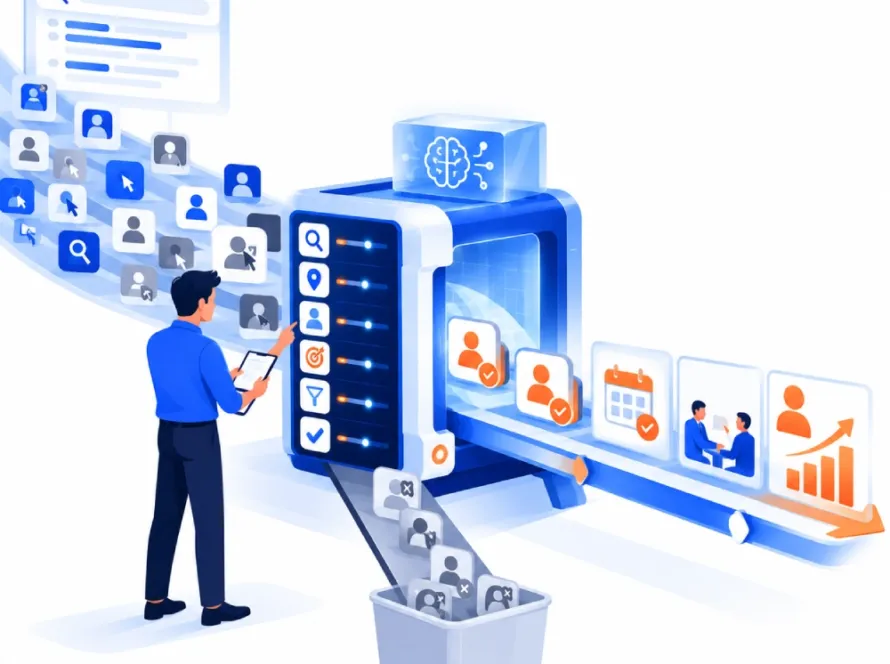
7. Measure Lead Quality and Feed It Back
Lead-generation businesses should move beyond a simple ‘lead / no lead’ model.
Useful stages might include:
- Lead received
- Valid lead
- Marketing-qualified lead
- Sales-qualified lead
- Appointment or site visit booked
- Opportunity created
- Sale closed
When enough data is available, higher-quality conversion stages can be passed back into advertising platforms so optimisation moves closer to the real business outcome.
8. Scale Budget in Controlled Steps
Scaling is not simply increasing a daily budget because yesterday looked good.
Increase spend gradually, monitor marginal efficiency and watch whether lead quality, conversion rate and acquisition cost remain healthy. A campaign that performs beautifully at ₹1 lakh per month may behave very differently at ₹5 lakh.
The objective is not maximum spend. It is maximum profitable scale.
How to Scale Campaigns Without Breaking Efficiency
Most campaigns do not scale linearly. As budgets increase, platforms reach broader audiences and more expensive inventory. Efficiency can therefore weaken.
A safer scaling process looks like this:
- Stabilise tracking before increasing budget.
- Identify campaigns producing the strongest downstream quality.
- Separate brand demand from new-customer acquisition where appropriate.
- Increase budgets in controlled steps rather than abrupt jumps.
- Refresh creative before fatigue becomes obvious.
- Expand keyword, audience or geographic coverage only when the economics support it.
- Watch qualified CPL, CAC and revenue—not only platform conversion volume.
This is where performance marketing becomes a management discipline rather than a campaign-launch service.

Which Performance Marketing Metrics Actually Matter?
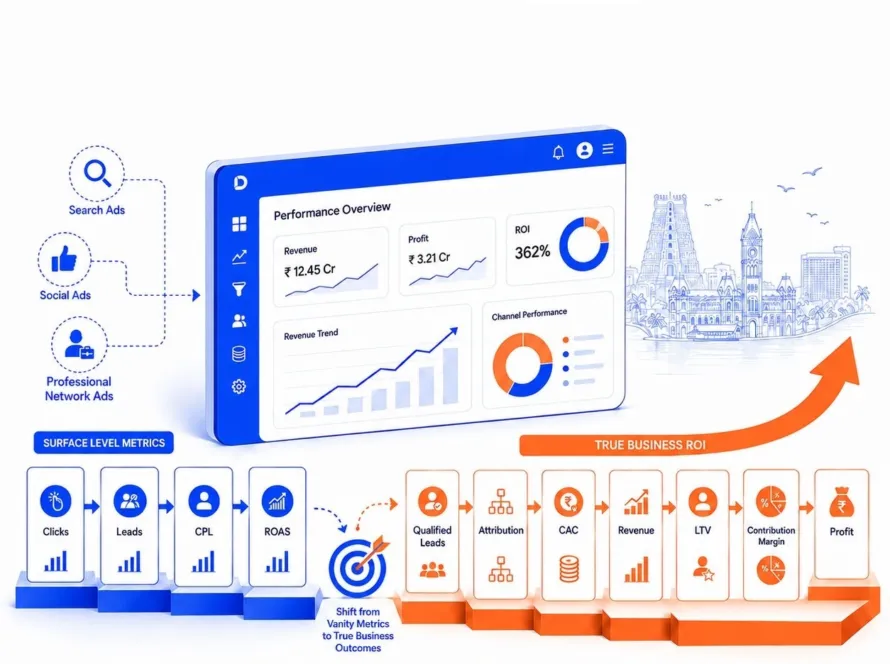
Not every metric deserves equal attention. A useful way to organise measurement is by how close the metric is to business value.
| Layer | Metrics | What It Tells You |
| Media efficiency | CPM, CPC, CTR | Useful for diagnosing delivery and creative response. |
| Conversion efficiency | CVR, CPL, CPA | Shows how efficiently traffic becomes an action. |
| Lead quality | Valid lead rate, MQL rate, SQL rate | Shows whether marketing is attracting the right prospects. |
| Sales efficiency | Close rate, CAC | Connects marketing with actual customer acquisition. |
| Business value | Revenue, contribution margin, LTV, payback | Shows whether growth is commercially sustainable. |
CPL is still useful. ROAS is still useful. The mistake is treating either as the complete picture.
What Performance Marketing Looks Like for Different Chennai Businesses
Real Estate
A plotted-development or apartment campaign may generate leads through Meta and Google, but the meaningful milestones are usually phone connection, site visit, booking intent and eventual sale.
A lower CPL campaign can easily be worse if the enquiries never progress to visits.
Education
For colleges, training institutes or overseas education providers, enquiry volume matters less than eligibility, course interest, counselling attendance and enrolment.
Healthcare
Appointment quality, service-line economics and location matter. A campaign for a high-value procedure should not be managed with the same logic as a campaign for a low-ticket consultation.
D2C and E-commerce
The focus shifts toward revenue, margin, new-customer acquisition, repeat behaviour and lifetime value. Scaling should account for product profitability, not merely platform ROAS.
B2B and SaaS
Longer sales cycles make lead quality and CRM feedback especially important. A campaign may look expensive at the lead level but become highly profitable if those leads produce larger contracts.

How to Choose a Performance Marketing Partner in Chennai
When comparing performance marketing services in Chennai, look beyond promises such as ‘more leads’ or ‘better ROAS.’ Those phrases are easy to print on a proposal.
A stronger partner should be able to explain:
- How campaign success will be connected to business goals
- What conversion events will be tracked
- How lead quality will be measured
- How creative testing will be organised
- How landing pages and conversion rate will be improved
- How CRM or offline sales data can be incorporated
- How budgets will be scaled without losing efficiency
- Which metrics will determine whether the programme is genuinely working
Also ask who actually owns the advertising accounts, tracking setup and data. Your business should retain appropriate administrative access to its own marketing assets.
Is Performance Marketing Right for Your Business?
Performance marketing is particularly useful when the business has a measurable conversion action and enough margin to invest in acquiring customers.
It tends to work best when:
- There is clear demand or a realistic way to create demand
- The business can respond to leads quickly
- The website or landing experience can convert traffic
- Sales outcomes can be tracked
- There is enough budget to test and learn
- Management is willing to optimise the full funnel rather than blame the ad platform for every problem
If those foundations are missing, increasing advertising spend may simply make the existing weaknesses more expensive.
A Better Way to Think About Performance Marketing
At Ditatics, performance marketing is most useful when media execution and analytics are treated as one system.
The workflow should connect campaign data with landing-page behaviour, lead quality, CRM stages and sales outcomes. That creates a feedback loop: better data improves optimisation, better optimisation improves lead quality, and better lead quality makes future budget decisions more confident.
This is also where analytics becomes operational rather than decorative. A dashboard should not merely explain what happened last month. It should help decide what to change next.
Final Thoughts
Scaling leads without wasting ad spend is not achieved by finding one magical campaign setting.
It comes from connecting business economics, reliable tracking, channel strategy, creative testing, conversion experience, lead-quality feedback and disciplined budget growth.
For Chennai businesses evaluating performance marketing services, that is the standard worth looking for.
The real question is not ‘How many leads can we buy?’ It is ‘How much profitable demand can we build and scale?’
Key Takeaways
- Performance marketing is a full acquisition system, not simply Google Ads or Meta Ads management.
- Cheap leads can become expensive when lead quality and sales conversion are ignored.
- Reliable tracking and downstream conversion data give advertising platforms better optimisation signals.
- Creative, landing pages and sales follow-up can waste as much budget as poor media targeting.
- Scale budgets gradually and monitor marginal efficiency instead of assuming performance will remain linear.
- For lead-generation businesses, qualified CPL and CAC are more useful than raw lead volume alone.
- The strongest performance marketing programmes connect paid media with analytics, CRM and actual business outcomes.
Frequently Asked Questions (FAQ)
Performance marketing services are measurable marketing activities focused on outcomes such as leads, customers, sales or revenue. They commonly include paid search, paid social, creative testing, landing-page optimisation, analytics, conversion tracking and ongoing campaign optimisation.
Digital marketing is the broader category and can include SEO, social media, content, email and brand activity. Performance marketing is more directly focused on measurable acquisition outcomes and optimisation against defined business goals.
There is no universal good CPL. A profitable CPL depends on lead quality, close rate, average customer value, gross margin and the maximum customer acquisition cost the business can sustain.
Yes. As budgets grow, campaigns may reach broader audiences or more expensive inventory. Scaling should therefore be gradual and evaluated using qualified lead cost, CAC and revenue rather than budget alone.
Ask how the agency measures lead quality, tracks sales outcomes, tests creative, manages landing pages, integrates CRM data, decides when to scale budgets and reports performance beyond surface-level metrics.

1 Comment
Comments are closed.