For most growing businesses, the choice between a performance marketing agency in Chennai and an in-house team depends on scale, complexity and control. An agency usually gives faster access to specialists, tools and cross-channel experience; an in-house team offers deeper day-to-day business knowledge and tighter internal coordination. The strongest model for many businesses is eventually hybrid: internal ownership of strategy and customer knowledge, supported by an external performance and analytics partner for specialist execution, measurement and scale.
There is no universal winner. A two-person SaaS company, a multi-location jewellery retailer and a real-estate developer running several projects should not build the same marketing organisation.
The useful question is not ‘agency or in-house?’ in isolation. It is: which operating model gives your business the right combination of expertise, speed, accountability, data access and economics at its current stage?
The right marketing model is the one that improves decision quality as the business grows—not merely the one that looks cheaper on a spreadsheet.
What Is the Real Difference Between an Agency and an In-House Team?
An in-house team sits inside the business. Its biggest advantage is proximity: the team understands products, customers, sales conversations, internal priorities and operational constraints at close range.
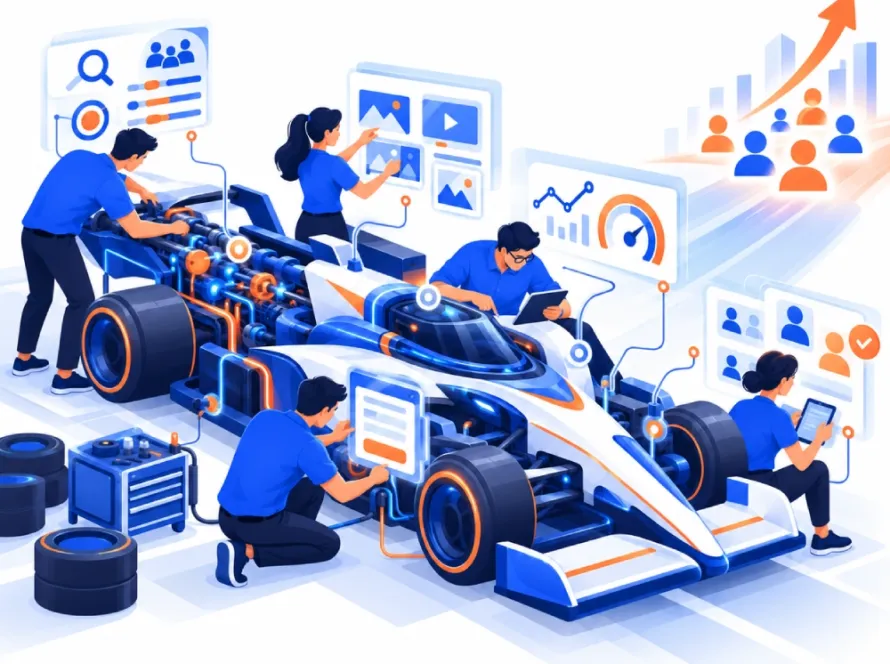
A performance marketing agency sits outside the organisation but usually works across multiple accounts, industries, platforms and campaign structures. Its advantage is breadth: specialists can bring pattern recognition, tools, testing experience and a wider view of what is changing across paid media and analytics.
Neither advantage is automatically superior. The decision depends on which gaps matter most to your business right now.
Performance Marketing Agency vs In-House Team: Quick Comparison
| Decision Area | Agency | In-House |
| Specialist expertise | Immediate access to multiple specialists | Depends on who you can hire and retain |
| Business knowledge | Must be learned through onboarding and collaboration | Usually stronger day-to-day context |
| Speed to start | Usually faster | Recruitment and onboarding take time |
| Cross-channel capability | Often broader from day one | May require several hires |
| Control | Shared through process and reporting | Direct internal control |
| Creative / testing breadth | Can draw on broader campaign experience | Deep brand familiarity but may have narrower exposure |
| Analytics / tracking | Specialist capability may be available immediately | Requires the right technical talent |
| Scalability | Can expand expertise without hiring each role | More hiring needed as complexity grows |
| Knowledge retention | Needs strong documentation and account ownership | Knowledge remains inside the organisation |
| Best fit | Fast growth, specialist gaps, multi-channel execution | Stable scale, strong internal capability, high need for daily integration |
When Does Hiring a Performance Marketing Agency Make More Sense?
An agency is usually the stronger choice when the business needs several capabilities immediately but does not yet have enough scale to build every specialist role internally.
1. You Need More Than One Specialist
Modern performance marketing can involve paid search, paid social, creative testing, landing pages, analytics, tracking, dashboards, CRM integration and reporting.
Hiring one person and expecting them to be equally strong in every area is optimistic bordering on mythological.
2. You Need to Move Faster Than Recruitment Allows
Recruiting good specialists takes time. An agency can often provide a functioning team faster, which matters when the company is launching a new product, entering a new market or trying to fix an underperforming acquisition system.
3. Your Campaigns Need Better Measurement
If Google Ads, Meta Ads, website analytics and CRM data are disconnected, the problem is no longer simply campaign management.
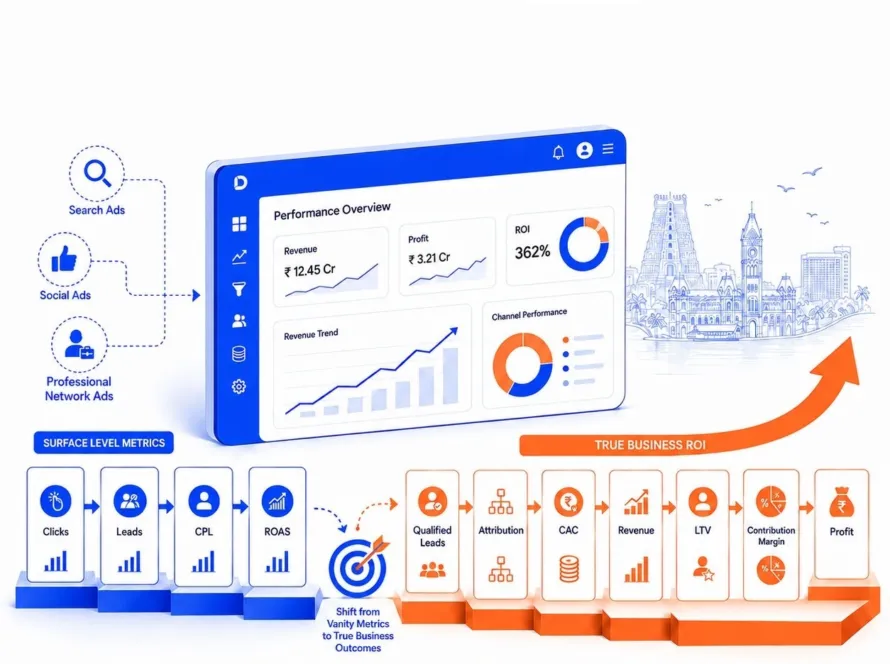
A performance and analytics partner can help establish the measurement layer needed to understand qualified leads, acquisition cost and revenue rather than stopping at platform-reported conversions.
4. Your Business Is Scaling Across Channels
As businesses move from one acquisition channel to several, coordination becomes more difficult. An agency can provide specialists who already understand how paid search, paid social, retargeting, creative and measurement interact.
5. You Want External Pattern Recognition
Internal teams know their own business deeply. Agencies often see recurring patterns across many campaigns: creative fatigue, tracking failures, bidding mistakes, weak lead quality and broken landing journeys.
That outside perspective can help challenge habits that have quietly become ‘the way we always do it.’

When Does an In-House Team Make More Sense?
In-house is often the stronger model when marketing is strategically central enough to justify dedicated specialists and the business needs constant integration with product, sales or operations.
1. Marketing Requires Daily Cross-Functional Collaboration
Businesses with fast-changing products, complex internal workflows or constant coordination between marketing, product and sales may benefit from having key decision-makers inside the company.
2. You Have Enough Scale to Build Specialist Roles
Once the acquisition programme is large and stable enough, full-time media buyers, analysts, creative strategists or lifecycle marketers can become economically sensible.
3. Proprietary Customer Knowledge Is a Major Advantage
Some businesses rely on subtle product knowledge, customer feedback or internal data that is difficult for an external team to absorb quickly.
4. Marketing Is a Core Competitive Capability
For some D2C, SaaS and marketplace businesses, acquisition itself becomes part of the company’s operating advantage. In those cases, keeping strategic knowledge and experimentation capability internally can be valuable.
Does In-House Automatically Mean Cheaper?
Not necessarily. Comparing an agency retainer with one employee’s salary is usually the wrong comparison.
A serious in-house performance operation may require some combination of a performance marketer, creative resource, analyst, designer or video resource, web/CRO support and marketing technology expertise.
There are also recruitment costs, software, training, management time and the risk of capability gaps when one key person leaves.
Agencies have their own costs and trade-offs, but the economic comparison should be team capability versus team capability—not one monthly invoice versus one salary.

Does Hiring an Agency Mean Losing Control?
It should not.
A healthy agency relationship should increase visibility into marketing performance, not reduce it. The client should retain appropriate administrative access to ad accounts, analytics properties, website data and CRM information.
The agency should also document what is being tested, what changed, why it changed and what the results mean.
Outsourcing execution is not the same thing as outsourcing ownership.
What About a Hybrid Model?
For many growing businesses, hybrid is eventually the most practical model.
The company keeps internal ownership of brand, customer knowledge, commercial goals and perhaps marketing leadership. An external performance marketing partner provides specialist execution, measurement, media expertise and additional capacity.
A hybrid structure might look like this:
- Internal team owns brand, product knowledge, offers and sales alignment.
- Agency manages Google Ads, Meta Ads and performance optimisation.
- Analytics and CRM data are shared through agreed reporting and feedback loops.
- Creative production is split between internal brand resources and external performance testing.
- Both sides review qualified leads, customer acquisition cost and revenue together.
The strongest agency-client relationships behave less like vendor management and more like one operating team with clearly divided responsibilities.
What Should Growing Chennai Businesses Consider?
Chennai’s business landscape is unusually varied: real estate, manufacturing, healthcare, education, retail, jewellery, SaaS, D2C and B2B services can all sit within the same city and still require completely different acquisition models.
That makes local context useful, but only when it changes decisions.
For example, a real-estate business may care heavily about geography, site visits and call follow-up. A multi-store retailer may need to connect digital campaigns with store performance. A SaaS company may care more about qualified demos, pipeline and longer sales cycles.
A performance marketing agency in Chennai should therefore understand the local market without forcing every Chennai business into the same ‘local marketing’ template.
A Practical Decision Framework
Use these questions before choosing your operating model:
| Question | What It Suggests |
| Do we need multiple specialist skills now? | Agency or hybrid is usually more practical. |
| Do we have enough budget and work to keep specialists fully utilised? | If yes, in-house becomes more attractive. |
| Is our biggest problem execution capacity or internal business knowledge? | Capacity points toward agency; knowledge-heavy integration may favour in-house. |
| Do we have reliable analytics and CRM feedback? | If not, prioritise whichever model can build the measurement foundation fastest. |
| How fast must we move? | Urgent launches or turnarounds often favour agency support. |
| Do we want long-term internal capability? | Consider a hybrid model with deliberate knowledge transfer. |
How Ditatics Fits This Decision
Ditatics is designed for businesses that do not want performance marketing and analytics to operate as separate functions.
The role is not simply to run Google Ads or Meta Ads. The goal is to connect campaigns with measurement, lead quality, customer journeys and downstream business outcomes so that media decisions are supported by stronger evidence.
For businesses that already have an internal marketing team, that can mean operating as a specialist performance and analytics partner rather than replacing the team. For businesses without in-house depth, it can mean providing the performance-marketing layer while the company retains ownership of its brand, sales process and customer knowledge.
The exact model should follow the business problem. Agency versus in-house is not a religion. It is an operating-design decision.
About Ditatics
Ditatics is a Chennai-based data-driven digital marketing and performance marketing partner that connects campaigns, analytics and business outcomes.
Its work combines performance marketing, digital marketing analytics, customer journey measurement and data-backed decision-making to help businesses understand not only what marketing generated, but what happened after the click or lead.
Final Thoughts
A performance marketing agency and an in-house team solve different organisational problems.
Choose an agency when you need specialist depth, speed and broader execution capability. Build in-house when marketing is large enough, stable enough and strategically important enough to justify dedicated internal specialists.
And when you need both deep internal context and specialist external capability, use a hybrid model rather than forcing a false either-or decision.
The best structure is the one that keeps customer knowledge close, specialist capability strong and performance data connected to business decisions.
Key Takeaways
- Agencies usually offer faster access to specialist skills, while in-house teams have deeper daily business context.
- Compare total capability, not an agency retainer against the salary of one employee.
- Growing multi-channel programmes often benefit from agency or hybrid support before the business can justify several specialist hires.
- In-house becomes more attractive when marketing is a core capability and there is enough scale to support dedicated roles.
- A hybrid model can combine internal ownership with external performance, analytics and execution expertise.
- For Chennai businesses, local knowledge matters only when it changes targeting, messaging, channel strategy or measurement.
- Whichever model you choose, retain ownership and access to your ad accounts, analytics and customer data.
Frequently Asked Questions (FAQ)
Choose based on the capabilities you need. An agency is usually stronger when you need several specialists quickly; an in-house marketer is stronger when daily business context and internal coordination are the priority. Many growing companies eventually use a hybrid model.
Depending on scope, it may manage Google Ads, Meta Ads, campaign strategy, creative testing, conversion tracking, landing-page performance, analytics, lead-quality feedback and reporting.
Yes. A hybrid model is common and can work extremely well. The internal team can own brand, customer knowledge and commercial priorities while the agency provides specialist media, analytics and execution support.
Beyond media metrics, both should track conversion rate, qualified lead rate, customer acquisition cost, sales conversion and revenue where the data is available.
A hybrid model is often effective because it preserves internal strategic ownership while adding external specialist capacity. The exact answer depends on marketing scale, hiring plans, data maturity and how quickly the business needs to move.