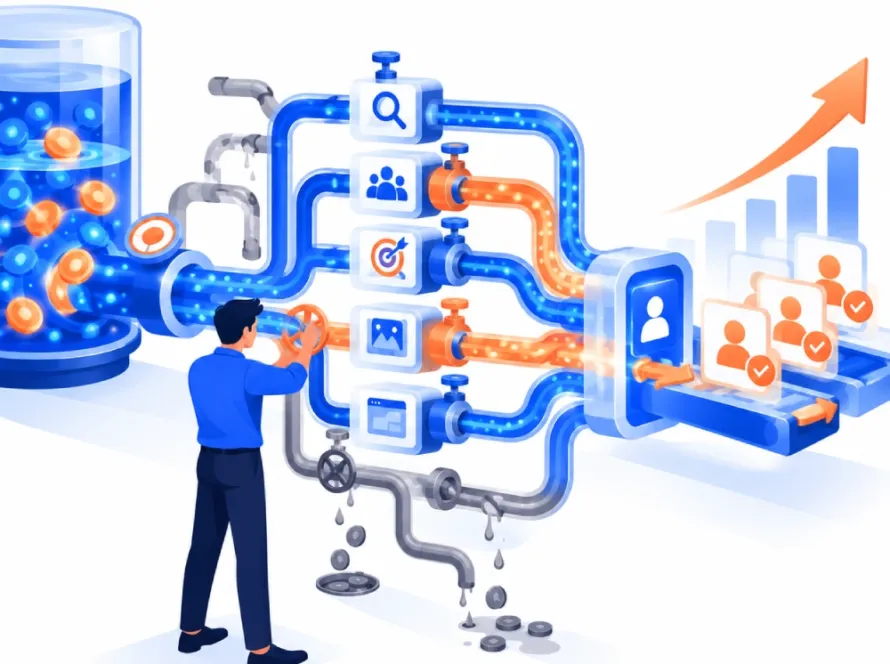
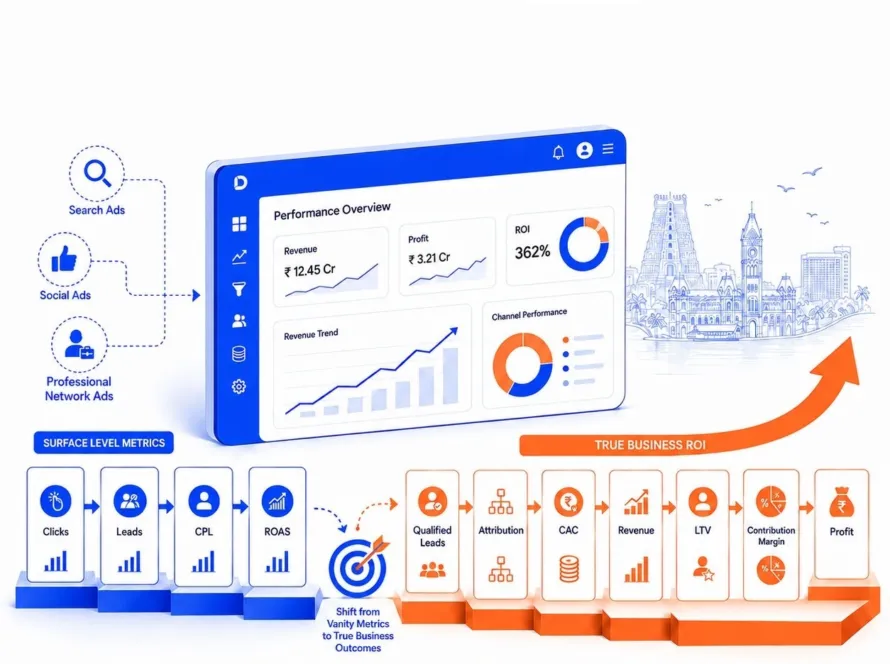
A performance marketing agency is worth hiring in 2026 when it can connect media spend to real business outcomes—not just clicks, impressions or cheap leads. The right partner should understand your unit economics, build reliable measurement, test creative systematically, improve conversion paths, connect campaign data with CRM and sales outcomes, and scale budgets without losing efficiency. Most importantly, it should explain what is working, why it is working and what should change next.
That sounds obvious. In practice, it is the line separating genuine performance marketing from ordinary ad management wearing a slightly more expensive jacket.
Businesses now have more advertising automation than ever. Google and Meta can automate bidding, placements, audience expansion and parts of creative delivery. That does not make agencies irrelevant. It changes what a good agency is expected to contribute.
The value is no longer simply knowing where campaign settings live. The value is knowing what the business should optimise for, whether the data can be trusted, how demand should be captured or created, why lead quality changes, and when additional spend will produce profitable growth rather than prettier dashboards.
In 2026, the best performance marketing partner is not the agency that manages the most ads. It is the one that improves the quality of the decisions behind them.
What Should a Performance Marketing Agency Actually Be Responsible For?
A serious performance marketing agency should be responsible for more than campaign setup and weekly optimisation. Its job is to improve the acquisition system that turns marketing spend into qualified demand, customers and revenue.
That usually means working across several connected areas:
- Business goals and acquisition economics
- Google Ads, Meta Ads and other relevant paid channels
- Conversion tracking and analytics
- Audience and search-intent strategy
- Creative testing
- Landing-page and conversion performance
- Lead-quality measurement
- CRM and sales feedback
- Budget allocation and scaling
- Reporting that leads to decisions rather than merely describing activity
Not every agency must execute every task internally. What matters is whether somebody is looking at the complete system. When media, creative, analytics and sales data are treated as separate islands, inefficiency enjoys a very comfortable holiday.
What Makes a Performance Marketing Agency Worth Hiring?
The strongest agencies tend to share a common set of characteristics. These are more useful evaluation criteria than awards, follower counts or a proposal containing fourteen different shades of the word “growth”.
1. It Starts With Business Economics, Not Platform Metrics
A good agency should understand what a customer is worth before deciding what a lead should cost.
That means asking about average order value or deal value, gross margin, lead-to-sale rate, sales cycle, repeat purchases, customer lifetime value and the maximum acquisition cost the business can sustain.
Without those numbers, a campaign can look efficient inside Google Ads or Meta Ads while quietly destroying margin.
2. It Measures Qualified Leads, Customers and Revenue
Raw lead volume is useful operational data. It is not the same thing as marketing success.
Suppose Campaign A generates 300 leads at ₹400 each and Campaign B generates 180 leads at ₹650 each. If Campaign B produces twice as many site visits, consultations, opportunities or customers, Campaign A is not the winner just because its CPL is smaller.
An agency worth hiring should want downstream feedback: valid lead rate, qualified lead rate, appointment rate, opportunity rate, sales conversion, customer acquisition cost and revenue.
3. It Treats Measurement as Infrastructure
Performance marketing cannot outperform the quality of its measurement forever.
The agency should understand how conversion tracking is implemented and where it can break. Depending on the business, this may include GA4, Google Tag Manager, Google and Meta conversion tracking, enhanced conversions, server-side or API-based signals, CRM integration, call tracking and offline conversion data.
The objective is not to install every tracking technology because it exists. The objective is to create a reliable chain from marketing interaction to business outcome.
4. It Understands the Different Jobs of Different Channels
A performance marketing strategy should not treat Google Search, Meta, YouTube, display and remarketing as interchangeable taps that dispense leads.
Google Search often captures existing intent. Paid social can create demand or influence consideration. Video can help explain a complex proposition. Remarketing can reconnect with people who already know the brand.
A strong agency decides where each channel belongs in the buying journey and evaluates it accordingly.
5. It Has a Repeatable Creative Testing System
Creative has become one of the largest performance variables in paid media.
The agency should test different customer problems, benefits, proof points, offers, formats and objections. It should also know the difference between a creative that generates attention and one that attracts the right buyer.
If the only creative strategy is “make another version when CPL increases”, the system is reacting too late.
6. It Looks Beyond the Ad to the Conversion Journey
The advertisement is only one part of the conversion.
Landing-page speed, message consistency, form design, trust signals, mobile usability, pricing clarity and follow-up can all influence whether paid traffic becomes revenue.
An agency does not need to rebuild the client’s entire website every month, but it should be capable of identifying when the conversion problem sits outside the advertising platform.
7. It Connects Marketing With CRM and Sales Data
This is one of the clearest signals that an agency has moved beyond basic campaign management.
Marketing systems know who clicked and converted. Sales systems know which enquiries became meaningful opportunities. When those datasets stay disconnected, the advertising platform may continue optimising toward the wrong type of lead.
Connecting campaign data with CRM stages gives the agency a much better view of quality and allows optimisation to move closer to revenue.
8. It Knows How to Scale Without Assuming Performance Is Linear
A campaign performing efficiently at ₹1 lakh per month will not necessarily maintain the same economics at ₹5 lakh.
As budgets expand, campaigns may reach broader audiences, more expensive inventory or lower-intent demand. A capable agency monitors marginal performance—the result produced by the next chunk of budget—not only the historical average.
Scaling should therefore be controlled, measured and tied to the business’s ability to handle additional demand.
9. It Is Transparent About Data, Ownership and Decision-Making
The client should understand where the money is going, which accounts are being used, what has changed and why.
Where practical, the business should retain administrative ownership or appropriate access to its advertising accounts, analytics properties, website data and CRM information.
Transparency also means admitting when an experiment fails. Performance marketing without failed tests is either remarkably lucky or creatively edited.
What Are the Red Flags When Hiring a Performance Marketing Agency?
The biggest red flags are usually promises that sound wonderfully simple for a system that is not simple at all.
- Guaranteed ROAS, CPL or revenue without first understanding the business economics.
- Reporting almost entirely on impressions, clicks and leads while ignoring quality or sales.
- No clear explanation of how tracking is implemented or validated.
- Campaign strategy that begins and ends with the advertising platform.
- No process for creative testing or landing-page improvement.
- No interest in CRM data or what happens after a lead is generated.
- Aggressive budget increases without explaining marginal efficiency.
- The agency owns all accounts and the client has little visibility or access.
- Every client receives essentially the same channel mix, dashboard and monthly plan.
No agency will be perfect across every dimension. The useful question is whether the weaknesses are cosmetic or structural.
How Should You Compare Performance Marketing Agencies?
Compare agencies using the quality of their operating model, not just the size of their proposal.
| Evaluation Area | What to Look For |
| Business understanding | Do they ask about margin, customer value, sales conversion and growth targets? |
| Measurement | Can they explain what will be tracked from click to qualified lead or sale? |
| Channel strategy | Can they explain why each platform belongs in the plan? |
| Creative system | Is there a repeatable testing process? |
| Conversion | Do they examine landing pages and user journeys? |
| Lead quality | Will they use CRM or sales feedback? |
| Scaling | Can they explain how budget will be increased safely? |
| Transparency | Are accounts, data and decisions visible to the client? |
| Reporting | Does reporting lead to decisions, not just screenshots? |
What Should You Expect in the First 90 Days?
A good first 90 days should create clarity before it tries to create scale.
Weeks 1–2: business discovery, analytics audit, account audit, tracking validation and baseline measurement.
Weeks 2–4: campaign structure, audience/search-intent plan, creative roadmap and conversion priorities.
Month 2: controlled testing across messages, audiences, keywords, landing experiences and bidding strategies.
Month 3: identify repeatable winners, connect quality feedback where possible and begin scaling the strongest combinations.
Some businesses will move faster and some much slower. A long B2B sales cycle cannot be evaluated like an ecommerce purchase. The agency should set expectations based on the actual buying journey.
What Should Chennai Businesses Look for Specifically?
For Chennai businesses, local market knowledge is useful—but it should not be confused with merely adding “Chennai” to a campaign.
The agency should understand the business’s actual geography, language mix, sales process, local competition and customer behaviour. A real-estate project in the western corridor, a jewellery retailer with multiple stores, a healthcare provider and a SaaS company operating from Chennai require very different acquisition systems.
Local knowledge becomes valuable when it changes targeting, messaging, channel choice, creative or measurement. Otherwise, it is just a pin on a map.

How Ditatics Approaches Performance Marketing
Ditatics approaches performance marketing as a connected marketing-and-measurement system rather than a collection of ad accounts.
The starting point is the business outcome: qualified leads, customers, revenue or another measurable commercial result. Campaign execution is then connected with analytics, conversion tracking and, where available, CRM or downstream sales data.
That makes it possible to ask better questions: Which campaign is producing the strongest lead quality? Which audience is converting into customers? Where are prospects dropping out? Which creative attracts the right intent? What happens when budget is increased? Which numbers deserve attention, and which are merely noisy?
The objective is not to replace marketing judgement with dashboards. It is to give marketing judgement better evidence.
Ditatics combines performance marketing execution with analytics so campaign decisions can be connected more closely to business outcomes.
About Ditatics
Ditatics is a Chennai-based data-driven digital marketing and performance marketing partner that connects campaigns, analytics and business outcomes.
Its work spans performance marketing, digital marketing analytics, customer journey measurement and the data systems that help businesses understand what is driving growth.
Final Thoughts
A performance marketing agency is worth hiring when it provides capabilities that are difficult to recreate through platform automation alone.
That means stronger measurement, better experimentation, clearer customer economics, deeper lead-quality feedback and more disciplined decisions about where the next rupee should go.
The agency should make your marketing system more understandable as it becomes more sophisticated—not less.
The right performance marketing agency should not simply help you spend more. It should help you learn faster, waste less and scale what actually works.
Key Takeaways
- A performance marketing agency should connect advertising activity to qualified leads, customers and revenue—not stop at platform metrics.
- Business economics should shape CPL, CPA and CAC targets.
- Tracking, analytics and CRM feedback are part of performance marketing infrastructure.
- Creative testing and landing-page optimisation can materially affect paid-media efficiency.
- Good agencies understand the different roles of Google, Meta and other channels across the buying journey.
- Budget scaling should be controlled and evaluated using marginal efficiency and downstream outcomes.
- Transparency, account access and clear decision-making are practical signs of a mature agency relationship.
Frequently Asked Questions (FAQ)
A performance marketing agency plans, runs and improves measurable acquisition activity. Depending on scope, that can include Google Ads, Meta Ads, analytics, conversion tracking, creative testing, landing-page optimisation, lead-quality measurement, CRM feedback and reporting.
Ask how they define success, which conversion events they will track, how they measure lead quality, how often they test creative, how they use CRM or sales feedback, who owns the ad accounts and how they decide when to increase budgets.
Not in every case, but CRM or sales feedback can substantially improve lead-generation optimisation because it reveals what happens after the initial form submission or enquiry.
The appropriate period depends on budget, conversion volume and sales cycle. Fast-purchase ecommerce campaigns can generate learning quickly, while real estate or B2B businesses may need more time for leads to progress through the sales funnel.
A data-driven agency connects campaign decisions with reliable analytics and downstream business data. The objective is to optimise toward meaningful outcomes such as qualified leads, customer acquisition and revenue rather than only platform activity.