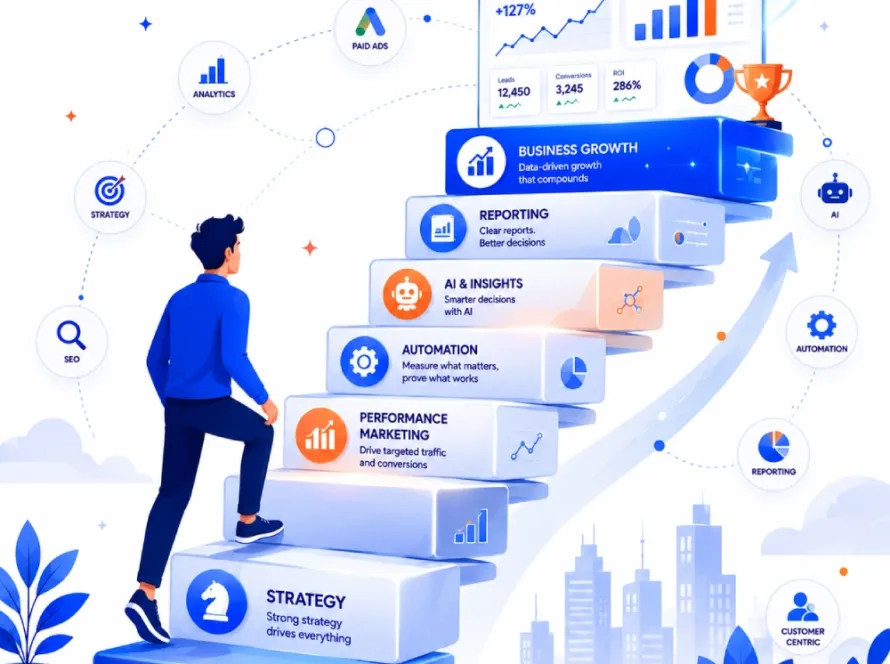
Introduction
Every agency website can look impressive. The case-study thumbnails are polished, the service list is long, the awards wall glows nicely, and somewhere on the homepage the agency is described as “leading,” “top,” “trusted” or “renowned.” That is marketing doing what marketing does: presenting the strongest possible version of the story.
The harder question for a business is whether the reputation is real – and whether it is relevant to the problem you are trying to solve.
If you are looking for a renowned digital marketing agency in Chennai, the safest approach is not to judge the agency by adjectives. Judge it by evidence. Look at the proof behind its claims, the process behind its work and the performance logic behind its reporting. Reputation matters, but reputation without a repeatable operating system is mostly decoration.
This is especially important in 2026, when digital marketing is no longer limited to campaign execution. A serious agency may be expected to connect paid media, SEO, creative, analytics, CRM data, automation, customer journeys and sometimes offline sales. The more complex the marketing system becomes, the less useful superficial signals become.
The goal of this guide is simple: help you separate genuine capability from well-presented noise.
Do not ask, "Does this agency look successful?" Ask, "Can this agency show how it creates, measures and improves success?"
Reputation Is Earned, Not Claimed
A renowned agency is not simply an agency that appears frequently in search results or has a large social following. Visibility can be purchased. Reputation is harder to manufacture because it accumulates through repeated delivery, client trust, clear thinking and evidence of business impact.
That does not mean awards, testimonials or recognisable clients are irrelevant. They can be useful signals. But no single signal should carry the entire decision. A respected agency should be able to explain how it works, what it measures, where it has succeeded, where a strategy did not work as expected, and what changed as a result.
This distinction matters because digital marketing outcomes are rarely produced by one dramatic tactic. Sustainable performance usually comes from dozens of smaller decisions made correctly over time: cleaner tracking, better segmentation, stronger search intent, sharper creative, improved landing pages, faster lead follow-up, budget reallocation, better attribution and more disciplined testing.
The reputation worth paying for is therefore not fame. It is reliability.
The Proof-Process-Performance Framework
A practical way to evaluate any digital marketing partner is to examine three layers: Proof, Process and Performance. Together, they reveal whether the agency can move from a persuasive pitch to repeatable execution.
Proof – evidence before promises
Proof answers the question: “What evidence suggests this team can solve problems like ours?” It includes case studies, client references, retention, specialist expertise, relevant industry experience, documented results and examples of reporting or strategy work. Good proof is specific enough to be examined, not merely admired.
Process – the system behind repeatable results
Process answers: “How does the agency produce the result?” A reputable team should be able to describe how it conducts discovery, sets KPIs, implements tracking, plans channels, develops creative, launches campaigns, tests hypotheses, reviews performance and communicates decisions. If the result depends entirely on one talented individual improvising every week, scalability and consistency become fragile.
Performance – outcomes that matter to the business
Performance answers: “What changed for the business?” The answer may involve qualified leads, customer acquisition cost, revenue, store visits, pipeline, repeat purchase, market share, organic visibility or another commercially relevant outcome. Reach and impressions may support the story, but they should not become the story when the business objective sits further down the funnel.
Expert perspective
Proof tells you whether an agency has done credible work. Process tells you whether it can do credible work again. Performance tells you whether that work mattered to the business.
What Proof Should You Ask an Agency to Show?
Case studies with context, not headline numbers
A case study that says “300% growth” sounds impressive. It is also incomplete. Growth from what baseline? Over what period? Was media spend increased? Was the market seasonal? Was the result revenue, traffic or impressions? Did the agency influence the full outcome or only one part of it?
The best digital marketing case studies provide enough context to understand the problem, intervention and result. They do not need to reveal confidential client data, but they should contain enough substance to show how the thinking worked.
Client retention and repeat work
Long client relationships can be a meaningful trust signal because agencies are relatively easy to replace. Repeat projects, expanded scopes and multi-year partnerships suggest that the relationship is creating continuing value. Retention is not proof of performance by itself, but it is stronger evidence than a one-time logo on a portfolio page.
Reviews, testimonials and references
Reviews are useful when they describe the working relationship in concrete terms: communication quality, responsiveness, strategic contribution, reporting clarity or measurable improvement. Generic praise such as “great team” is pleasant but not very diagnostic. For a significant engagement, asking for a reference conversation can provide far more signal than reading twenty short testimonials.
Measurement and platform capability
A modern agency should be able to explain its measurement stack in plain language. Depending on the scope, that may include GA4, Google Tag Manager, ad-platform conversion tracking, CRM integration, call tracking, dashboarding, offline conversion imports, ecommerce events or marketing automation. Certifications can support credibility, but the more important question is whether the team can turn tools into a trustworthy measurement system.
How to Read a Digital Marketing Case Study Properly
Case studies are often where reputation becomes persuasive, so they deserve a little healthy skepticism. You are not trying to disprove the result; you are trying to understand what the result actually means.
Start with the baseline
A percentage without a baseline can distort reality. Moving from 10 leads to 20 leads is 100% growth, but the commercial significance may still be small. Ask what the starting point was and whether the comparison period is fair.
Understand the intervention
What exactly changed? New campaign structure? Better tracking? A landing-page redesign? More budget? New creative? Brand demand created by an offline campaign? Strong case studies identify the actions that plausibly contributed to the result.
Check the measurement window
A two-week improvement can be useful evidence, but it is different from sustained performance over six months. Seasonal categories such as retail, jewellery, education and real estate can also produce large temporary swings. Time context matters.
Separate correlation from causation
Marketing operates inside a living business. Pricing changes, inventory, sales-team performance, competitor activity, festivals, product launches and macro conditions can all influence outcomes. A mature agency does not claim credit for every upward line. It explains what it can measure confidently and where uncertainty remains.
Why Process Matters More Than One Big Win
One spectacular campaign can happen for many reasons: excellent timing, a strong offer, unusually favourable media conditions or plain old luck. A reliable agency needs something more durable – a process that keeps producing sensible decisions when conditions are less generous.
That process should not be bureaucratic. It simply needs to make important work repeatable.
Discovery and business understanding
The agency should understand how the business makes money before deciding how marketing should work. That includes the sales cycle, margins, geography, customer segments, seasonality, existing demand, capacity and the definition of a valuable lead or customer.
Measurement and tracking
Tracking should be designed before major campaigns are scaled. Primary conversions, secondary signals, events, CRM fields, UTMs and reporting logic should be agreed rather than improvised after the first monthly review.
Strategy and channel planning
Channel selection should follow the customer journey and business objective. Search may capture existing intent. Meta may create and harvest demand. SEO may build long-term discoverability. Content may reduce uncertainty. CRM and automation may improve follow-up. There is no universal channel mix.
Testing, optimization and review
Strong teams operate with hypotheses. They test creative, audiences, offers, landing pages, bidding, keywords, messaging and nurture journeys, then document what was learned. The result is a marketing system that becomes smarter over time instead of merely busier.
What Performance Should Mean in 2026
A renowned digital marketing agency in Chennai should be comfortable moving the performance conversation beyond the ad platform. Different businesses need different measurement models, but several patterns now matter across industries.
Leads versus qualified leads
A campaign producing 1,000 leads is not automatically better than one producing 500. If the second campaign generates more prospects who meet the sales criteria and close at a higher rate, it may create significantly more value. For lead-generation businesses, raw CPL should therefore sit beside qualified-lead rate, appointment rate, opportunity rate and customer acquisition cost.
ROAS versus profitable growth
For ecommerce, platform ROAS is useful but incomplete. Discounts, returns, shipping, product margin, new-customer mix and repeat purchase can materially change the economics. A mature agency should understand why a campaign with lower headline ROAS can sometimes be healthier for the business.
Attribution and incremental impact
Google, Meta and other platforms may each claim influence over the same customer journey. Platform reporting helps optimization, but management reporting should be anchored in actual leads, transactions, CRM outcomes and, where practical, incrementality testing. Confidence is more valuable than false precision.
Online-to-offline outcomes
For Chennai businesses such as real estate, jewellery, malls, healthcare, education and automotive, digital marketing often influences an offline action. Store visits, site visits, calls, appointments, counselling sessions and dealer enquiries may matter more than an online purchase event. The measurement design should reflect that reality.
Transparency Is One of the Strongest Reputation Signals
Account ownership and access
Businesses should know where their assets live and who owns them. Advertising accounts, analytics properties, pixels, tag managers, domains, CRM integrations and dashboards should not become mysterious black boxes controlled entirely by the agency. Healthy partnerships are built on access and clarity, not hostage situations with nicer PowerPoints.
Reporting that explains decisions
A good report should answer three questions: What changed? Why does it matter? What are we doing next? Screenshots and metric dumps can support the answer, but they are not the answer. Reputation grows when clients consistently understand the logic behind decisions.
Clear attribution and limitations
No attribution model is perfect. A trustworthy agency explains the limitations of the data instead of presenting every platform number as objective truth. That level of honesty is not weakness; it is analytical maturity.
Red Flags That Reputation Marketing Cannot Hide
- Guaranteed rankings, guaranteed ROAS or guaranteed lead costs without understanding the business context.
- Case studies that present dramatic percentages but no baseline, timeframe or explanation of what changed.
- Reports dominated by reach, impressions and clicks when the agreed objective is qualified demand or revenue.
- No clear tracking or measurement plan before campaign launch.
- One identical strategy prescribed for every client regardless of industry, margin, sales cycle or geography.
- Reluctance to provide account access, raw data or a clear explanation of attribution.
- Constantly changing tactics without a documented testing rationale.
- Heavy use of AI language and automation claims without explaining where human strategy, data quality and governance fit.
- A sales pitch that sounds far more sophisticated than the team that will actually manage the account.
None of these alone proves that an agency is poor. But several together should slow the decision down.
A Practical Agency Evaluation Scorecard
A simple scorecard can make agency selection less emotional. Score each area from 1 to 5, then discuss the gaps rather than chasing a single grand total.
| Area | What to Evaluate | 1-5 Score | What Good Looks Like |
| Proof | Relevant case studies, references, retention, specialist experience | Specific evidence with context | |
| Process | Discovery, tracking, planning, testing, review rhythm | Repeatable and clearly explained | |
| Performance | KPIs connected to leads, customers, revenue or profit | Business outcomes, not vanity metrics | |
| Analytics | GA4, CRM, attribution, dashboard and data capability | Measurement built into strategy | |
| Transparency | Account access, reporting clarity, honest limitations | No black boxes | |
| Communication | Responsiveness, ownership, escalation and review quality | Clear decisions and next actions | |
| Strategic Fit | Understanding of business model, audience and market | Recommendations tailored to context |
The scorecard is not meant to turn agency selection into laboratory science. It simply forces the conversation toward evidence and away from presentation polish.
Why Chennai Market Understanding Matters – But Is Not Enough
Local market understanding can be valuable. Chennai has its own geography, language mix, retail patterns, property corridors, education markets, cultural calendar and business ecosystems. A team that understands these nuances may identify opportunities faster than one approaching the city as a generic pin on a map.
But “we are based in Chennai” is not a strategy. Local knowledge should complement strong marketing fundamentals: customer research, data quality, platform expertise, creative thinking, measurement and commercial understanding.
The strongest partner is therefore not necessarily the agency with the closest office. It is the agency that understands the market and can connect that understanding to a disciplined growth system.
Conclusion: Look for Evidence, Systems and Business Impact
The phrase “renowned digital marketing agency in Chennai” sounds like a reputation question. In reality, it is a risk-management question. You are deciding who will influence your brand, your media budget, your customer data and often your growth targets.
That decision deserves more than a portfolio browse and a price comparison.
Look for proof that can withstand questions. Look for a process that makes success repeatable. Look for performance reporting that connects marketing activity to business value. And pay close attention to transparency, because a good agency should make your marketing easier to understand, not harder.
At Ditatics, this thinking is captured in three words: Digital. Data. Decisions. Digital creates reach and interaction. Data creates understanding. Decisions determine whether the marketing compounds into sustainable growth.
Key Takeaways
- A renowned agency should be evaluated through proof, process and performance – not adjectives, awards or visibility alone.
- Case studies are strongest when they show the baseline, intervention, timeframe and commercially relevant outcome.
- Client retention, repeat work and specific references can provide useful evidence of trust and delivery consistency.
- A repeatable process for discovery, tracking, strategy, testing and reporting is more valuable than one isolated campaign win.
- Performance in 2026 should connect media metrics to qualified leads, customers, revenue, profitability or another genuine business outcome.
- Transparency around account ownership, attribution and reporting is one of the clearest signals of a healthy agency relationship.
- Chennai market knowledge is useful, but it should sit on top of strong analytics, strategy and performance fundamentals.
- The best agency for your business is not necessarily the most famous; it is the one that can demonstrate relevant capability and make better decisions with you over time.
Frequently Asked Questions (FAQ)
A strong reputation usually comes from consistent delivery, credible case studies, client retention, transparent communication and measurable business impact. Awards and visibility can support reputation, but they should not replace evidence of how the agency actually works.
Ask for relevant case studies, references, examples of reporting, information about account ownership and a clear explanation of how campaigns are measured. Trustworthy agencies are generally comfortable explaining their process and the limitations of their data.
Awards can be useful third-party recognition, but they should be treated as one signal among many. Evaluate whether the agency has experience relevant to your business, a clear operating process and evidence of outcomes that matter to you.
A useful case study should explain the original business problem or baseline, the strategy or intervention, the measurement period and the result. It should also provide enough context to understand whether the outcome was commercially meaningful.
Process makes results more repeatable. A strong agency should have a clear method for discovery, measurement, strategy, launch, testing, optimization and review. Without a process, good results may depend too heavily on individual improvisation or favourable conditions.