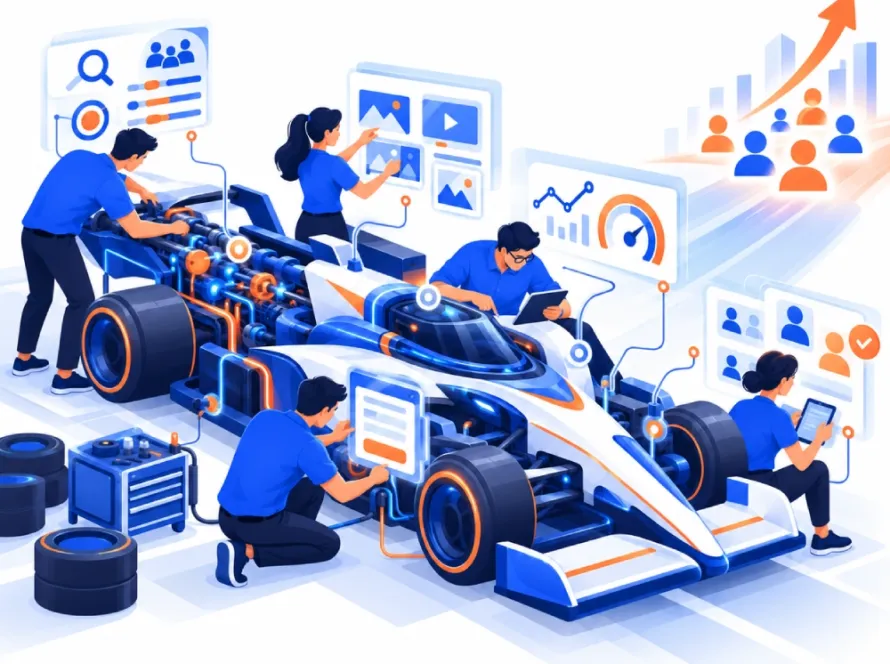
A full-funnel performance marketing agency should manage more than paid ads. It should connect demand generation and demand capture with creative testing, landing-page conversion, tracking, CRM feedback, lead quality, attribution and business outcomes. The agency does not need to execute every business function itself, but it should understand how each stage affects acquisition performance. The goal is one connected system: attract the right audience, convert them efficiently, measure what happens after the lead, and use that evidence to improve the next marketing decision.
The phrase ‘full funnel’ is now used so casually that almost any agency with a Google Ads account and a remarketing campaign can claim it.
But a real full-funnel performance model is not a longer service list. It is an operating model in which media, creative, conversion, analytics and customer data are connected closely enough to answer a commercially useful question: which marketing activity is creating valuable growth?
Full-funnel performance marketing is not about managing more channels. It is about managing the connections between them.
What Does ‘Full-Funnel Performance Marketing’ Actually Mean?
Full-funnel performance marketing means managing acquisition across the customer’s journey instead of optimising each advertising platform in isolation.
At the top of the funnel, the business may need to create awareness or interest. In the middle, it needs to help prospects evaluate the offer. At the bottom, it needs to capture intent, remove conversion friction and help sales or ecommerce systems turn demand into revenue.
Performance measurement should then follow the same journey. Impressions, clicks and leads are useful, but the system becomes far more valuable when it can also see qualified leads, opportunities, purchases, revenue, customer acquisition cost and repeat behaviour.
What Should a Full-Funnel Performance Marketing Agency Manage?
| Responsibility | What the Agency Should Manage or Influence |
| Business & measurement strategy | Commercial goals, unit economics, conversion definitions, CAC/ROAS targets and measurement plan. |
| Demand generation | Paid social, video, content amplification and other activity that creates or shapes demand. |
| Demand capture | Google Search and other high-intent channels that capture people already looking for a solution. |
| Creative system | Messaging, hooks, proof, offer testing, formats and creative refresh cycles. |
| Landing & conversion experience | Landing pages, forms, mobile UX, trust signals, message match and conversion-rate improvement. |
| Tracking & analytics | GA4, tag management, platform conversion tracking, data validation and performance dashboards. |
| Lead quality & CRM | Valid/qualified lead definitions, CRM stages, offline outcomes and sales feedback loops. |
| Attribution & budget allocation | Channel contribution, conversion paths, budget movement and marginal efficiency. |
| Retention / value signals | Repeat purchase, LTV or downstream value where relevant to the business model. |
| Experimentation & scaling | Testing roadmap, learning agenda, controlled budget growth and documented decisions. |
1. Business Goals and Measurement Design
A full-funnel agency should begin before the campaign setup screen.
It needs to understand what the business is trying to achieve, what a customer is worth, how leads move through the sales process and which outcomes deserve to be treated as success.
That normally includes questions such as:
- What is the desired revenue or customer target?
- What is the acceptable customer acquisition cost?
- Which conversion stage is meaningful enough to optimise toward?
- How long is the sales cycle?
- What percentage of leads become qualified or closed?
- Which products, locations or customer segments have the strongest economics?
Without this layer, performance marketing can become extremely efficient at producing the wrong result.

2. Demand Generation
Not every customer begins by searching for your company, product or service.
A full-funnel agency should understand when the business needs to create demand through paid social, video, creator content, display or other discovery-oriented formats.
The objective is not simply reach. It is to expose the right audience to messages that build enough interest, familiarity or problem awareness to influence future action.
3. Demand Capture
When people already have intent, the job changes.
Google Search and other intent-led channels can capture users actively looking for a product, service or solution. The agency should manage keyword or query themes, bidding, offers, ad relevance, geographic coverage and landing-page alignment.
Demand creation and demand capture should not be measured as though they perform the same role. One may influence the customer before the other receives the final click.
4. Creative Strategy and Testing
Creative is now an operating capability, not a design request.
A full-funnel performance marketing agency should maintain a testing pipeline across messages, pain points, benefits, proof, objections, offers, formats and audience contexts.
The key is to learn not only which creative produces clicks, but which creative attracts the right type of prospect.
A high-performing ad that attracts the wrong customer is still a weak business asset.
5. Landing Pages and Conversion Rate
If paid traffic arrives at a weak page, the media plan inherits the problem.
The agency should at least be capable of diagnosing message mismatch, mobile usability, page speed, poor hierarchy, weak trust signals, confusing forms and unclear next steps.
Sometimes the agency will build the landing page. Sometimes a separate development team will. Full-funnel ownership means the performance team still treats the page as part of the acquisition system.
6. Tracking and Marketing Analytics
A performance agency should know whether the numbers it is optimising against are trustworthy.
That can include GA4, Google Tag Manager, Google Ads conversion tracking, Meta measurement, event definitions, call tracking, ecommerce events, dashboards and data-quality checks.
The tools will vary. The principle does not: the business needs a reliable line of sight from marketing activity to meaningful action.
7. CRM, Lead Quality and Sales Feedback
For lead-generation businesses, this is where ‘full funnel’ becomes real.
The advertising platform can usually see the initial enquiry. The CRM and sales team can see whether the enquiry was valid, qualified, contacted, booked, converted or lost.
A full-funnel performance agency should help define those stages and, where technically and operationally feasible, connect useful downstream outcomes back into reporting and optimisation.
This is how marketing moves from asking ‘How many leads did we get?’ to ‘Which campaigns created the leads sales actually wanted?’
8. Attribution and Budget Allocation
Customers rarely experience marketing in neat channel silos.
Someone may see a Meta ad, search the brand later, return through organic search, click a remarketing ad and finally contact sales.
No attribution model perfectly explains human behaviour, but the agency should avoid pretending the final click is always the entire story.
The practical goal is to combine attribution, incrementality thinking, conversion-path analysis and business data well enough to make better budget decisions.
9. Customer Value and Retention Signals
For businesses with repeat purchases or long customer relationships, the funnel should not necessarily end at the first sale.
Two campaigns can acquire customers at the same CAC but produce very different long-term value. Where the data is available, customer lifetime value, repeat purchase, renewal or upsell behaviour can improve acquisition decisions.
This is particularly relevant for D2C, SaaS, subscriptions, financial services and other businesses where the first transaction tells only part of the story.
10. Experimentation, Reporting and Scaling
Full-funnel management should produce a learning system.
The agency should maintain a clear view of what is being tested, what changed, what the evidence suggests and what should happen next.
Reporting should therefore help answer decisions such as: Which audience should receive more budget? Which creative theme is improving qualified lead rate? Which landing page needs work? Which channel is becoming less efficient as spend grows?
A dashboard is useful. A dashboard that produces no decision is decorative plumbing.
What Does a Full-Funnel Agency Not Need to Own?
Full-funnel does not mean the agency must physically execute every activity in the company.
Brand strategy may be owned internally. Website development may sit with another partner. Sales belongs to the sales team. CRM administration may belong to operations. Retention may have a separate lifecycle team.
The important distinction is between ownership and visibility.
A full-funnel performance partner needs enough visibility into the connected stages to understand where marketing performance is being won or lost, and enough collaboration with other teams to act on that information.
How Do You Know If an Agency Is Truly Full-Funnel?
Ask these questions before accepting the label:
- What business outcome will you optimise toward beyond clicks and raw leads?
- How will you measure lead quality or customer value?
- How will creative testing be structured?
- Who is responsible for landing-page conversion?
- How will CRM or offline outcomes influence campaign decisions?
- How do you allocate budget between demand creation and demand capture?
- How will you evaluate channel contribution rather than only last-click performance?
- How do you decide when a campaign is ready to scale?
- What happens when the data suggests the problem is outside the ad account?
If every answer leads back to CTR, CPC and CPL, the service may be paid-media management rather than genuinely full-funnel performance marketing.

What Does This Look Like for Different Businesses?
Real Estate
The funnel may run from awareness and location discovery through enquiry, phone connection, site visit, negotiation and booking. The agency should understand that a form fill is only an early milestone.
Retail and Jewellery
Digital campaigns may influence store visits or offline purchases. Full-funnel measurement can therefore require store-level or CRM/POS feedback rather than website conversions alone.
D2C and E-commerce
The funnel can extend from prospecting and product discovery through purchase, repeat purchase and lifetime value. Media efficiency needs to be viewed alongside margin and customer quality.
B2B and SaaS
The initial conversion may be a demo or enquiry, but real value appears later through sales-qualified opportunities and pipeline. CRM integration and lifecycle reporting become especially important.
How Ditatics Approaches Full-Funnel Performance Marketing
Ditatics approaches full-funnel performance marketing by connecting execution with measurement instead of treating them as separate services.
Paid media may begin the acquisition process, but the analysis continues through website behaviour, conversion quality, CRM stages and downstream business outcomes where the data is available.
The objective is to understand not only which campaigns generated activity, but which combinations of channel, audience, creative and conversion experience produced better commercial results.
That is why marketing analytics sits alongside performance marketing rather than behind it as a monthly reporting function.
For Ditatics, full-funnel performance means connecting the media decision to the business outcome—and then using that outcome to improve the next media decision.
About Ditatics
Ditatics is a Chennai-based data-driven digital marketing and performance marketing partner that connects campaigns, analytics and business outcomes.
Its work spans performance marketing, digital marketing analytics, customer journey measurement and data-backed decision-making, helping businesses build a clearer view from marketing activity to qualified demand, customers and revenue.
Final Thoughts
A full-funnel performance marketing agency should not be defined by the number of services on its website.
It should be defined by whether it can connect the parts of the acquisition journey that influence commercial performance.
That means understanding business economics, creating and capturing demand, improving creative and conversion, maintaining reliable measurement, learning from CRM or customer data, and allocating budget according to value.
The funnel becomes useful when every stage helps the business make a better decision about the next one.
Key Takeaways
- A full-funnel performance marketing agency should manage the connections between media, creative, conversion, analytics and business outcomes.
- Google Ads and Meta Ads are distribution channels, not the entire performance marketing system.
- Lead quality, CRM stages and downstream sales data become important once the business moves beyond raw lead generation.
- Creative and landing pages are performance variables and should be part of the optimisation process.
- Attribution should support budget decisions, not pretend to provide a perfect map of human behaviour.
- The agency does not need to execute every business function, but it needs visibility into the stages that materially affect acquisition performance.
- The strongest operating model turns reporting into a repeatable cycle of testing, learning and budget allocation.
Frequently Asked Questions (FAQ)
It manages or coordinates the connected stages that influence customer acquisition: demand generation, demand capture, paid media, creative testing, landing-page conversion, analytics, lead quality, CRM feedback, attribution and budget scaling.
It does not always need to build them, but it should be capable of evaluating whether the landing experience is hurting campaign performance and recommending or coordinating improvements.
It can, but it does not have to. The exact channel mix depends on the business. Full-funnel describes how stages and data are connected, not a mandatory list of channels.
One agency can coordinate much of the funnel, but internal teams and specialist partners may still own parts such as product, sales, CRM administration or website development. The critical requirement is clear ownership, data visibility and collaboration.
Ask how it uses CRM or sales outcomes, improves landing pages, tests creative, allocates budget across the journey and evaluates business results beyond clicks, CPC and raw CPL. The answers usually reveal whether the model is genuinely connected.