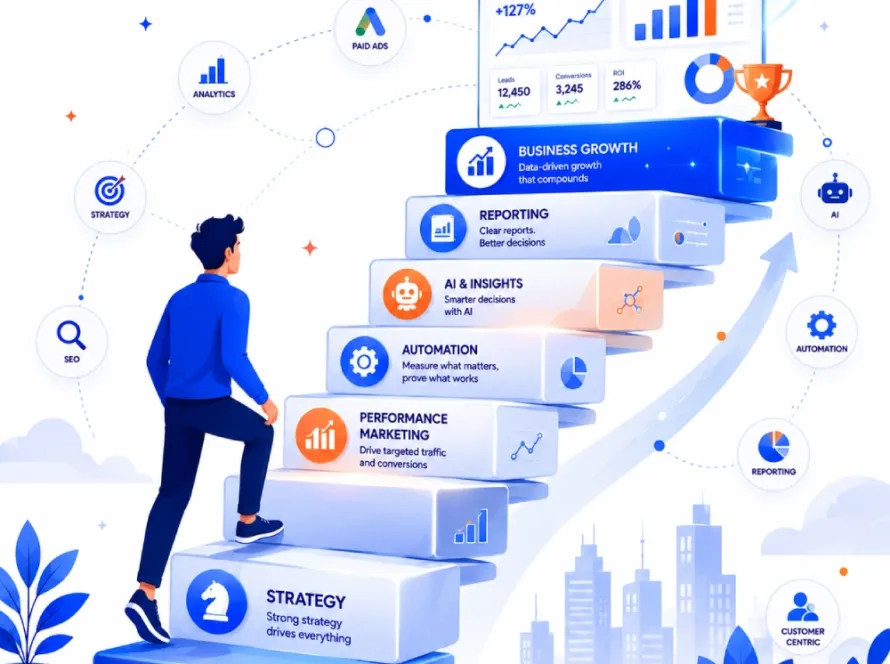
Running Google Ads is not a growth strategy. Posting consistently on Instagram is not a growth
strategy either. Neither is ranking a handful of keywords if the traffic never becomes a meaningful business outcome. Each of these activities can be valuable, but only when they are connected to a larger system.
That distinction is becoming important for businesses evaluating a leading digital marketing agency in Chennai. The market has matured. Many brands already run paid media, produce content,
maintain websites and track basic analytics. The harder question is no longer whether they are doing digital marketing. It is whether all those moving parts are working together.
A full-funnel growth system connects what happens before the click, after the click and after the
lead. It links strategy, demand creation, search intent, landing-page experience, CRM follow-up, sales outcomes, analytics and optimization. The objective is simple: make marketing easier to measure
and easier to improve.
That sounds obvious. In practice, it is where a surprising amount of marketing falls apart.
A business does not have a Google Ads problem, an SEO problem and a CRM problem in isolation. Ithas one customerjourney with several points where value can be created - or quietly lost.
Why a Leading Digital Marketing Agency in Chennai No Longer Works Channel by Channel
The traditional agency model is organized around channels. One team handles SEO. Another
manages Meta. Someone else builds the landing page. A sales team receives the leads. At the end of the month, everyone submits a report from their own platform.
The trouble is that customers do not experience brands in departments. A person may first
encounter a reel, later search the brand on Google, read a comparison page, return through a
remarketing ad, submit a form and finally convert after a WhatsApp conversation or phone call. If each touchpoint is measured separately, the business sees fragments instead of the journey.
A modern full-funnel agency therefore works backwards from the business outcome. What counts as success? A qualified site visit? A completed ecommerce order? A showroom walk-in? A booked consultation? A demo that turns into pipeline? Once that is clear, channels can be assigned roles rather than treated as independent projects.
This is a subtle but important shift. The agency is no longer asking, ‘How do we improve Meta Ads?’It is asking, ‘Where in the customerjourney are we losing profitable demand, and which intervention has the highest chance offixing it?’
What a Full-Funnel Growth System Actually Means
Full-funnel marketing is often misunderstood as ‘do everything everywhere.’ That is not the goal. A business with a modest local market does not need twelve channels simply because twelve channels exist. A good system uses the channels that match the customer journey, economics and maturity of the business.
The funnel itself is also more useful as a decision model than as a neat diagram. Awareness,
consideration, conversion and retention rarely happen in a straight line. People loop, compare, disappear, return and switch devices. The job of the system is not to force customers into a
cartoonishly tidy funnel. It is to create useful signals at each stage and connect those signals to business outcomes.
The Full-Funnel Growth Engine: 8 Connected Layers
| Layer | Key Question | Typical Outputs |
| 1. Business Goal & Measurement | What business result are we optimizing for? | KPI tree, economics, conversion definitions |
| 2. Audience & Market Intelligence | Who is most likely to create value? | Segments, intent, geography, demand insights |
| 3. Demand Creation | How will the market discover and remember us? | Meta, video, content, programmatic, social |
| 4. Demand Capture | How do we capture existing intent? | Search Ads, SEO, local search, high- intent landing pages |
| 5. Conversion Architecture | What happens after the click? | Landing pages, CRO, forms, offers, UX |
| 6. CRM & Nurture | What happens after the lead? | Lead scoring, WhatsApp/email flows, sales handoff |
| 7. Measurement & Attribution | Which touchpoints contribute to outcomes? | GA4, CRM, enhanced conversions, CAPI, dashboards |
| 8. Optimization & Scale | What should we change next? | Experiments, budget shifts, creative testing, forecasting |
1. Business Goal and Measurement Design
The strongest funnel starts before media planning. It begins with economics. What is a customer worth? How much can the business afford to spend to acquire one? Which outcomes matter:
enquiry, qualified enquiry, order, repeat order, appointment, store visit or pipeline value?
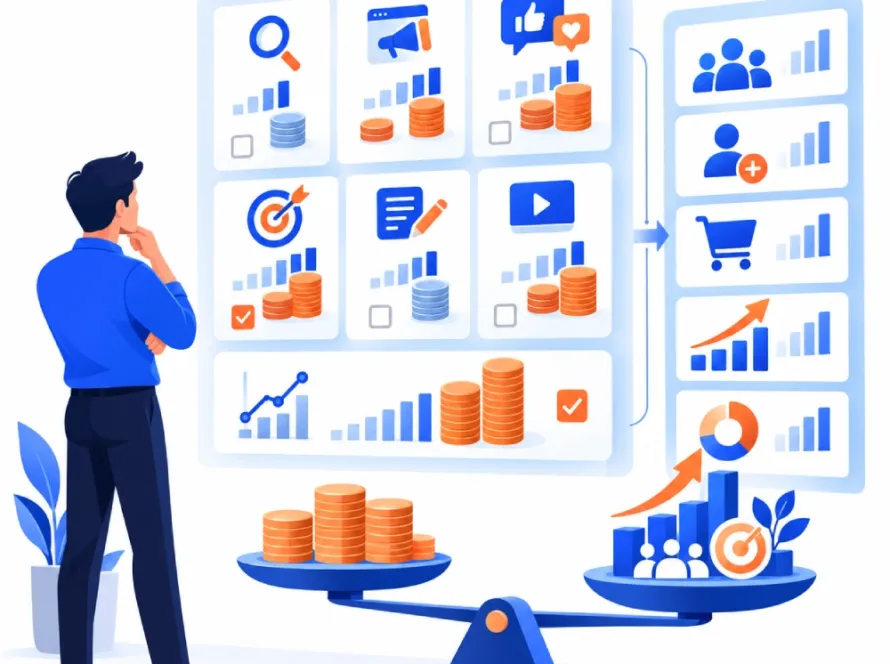
A lead-generation business that celebrates a low CPL without measuring lead quality is optimizing only the top half of the problem. A D2C brand that celebrates ROAS without considering margins or repeat purchase may also be misreading performance. A leading agency defines the decision metrics before choosing the channels.
2. Audience and Market Intelligence
Good targeting begins with more than platform interests. Search demand, CRM history, location performance, product preference, customer value and sales feedback can all reveal which segments deserve different messages or budgets.
For Chennai businesses, geography often matters in very practical ways. A real estate project, a jewellery showroom, a hospital and a B2B technology company may all operate in the same city, but their buying radius, consideration time and conversion signals are radically different. The funnel should reflect those differences.
3. Demand Creation
Not every customer begins with a search. Some categories need demand to be created before it can be captured. Video, Meta campaigns, creator content, programmatic media, social content and strong brand storytelling can introduce a problem, product or proposition before a person actively looks for it.
The mistake is measuring these channels only by immediate last-click conversions. Their job may be to create qualified attention, increase branded search, seed remarketing pools or move an unfamiliar audience into consideration. Measurement should reflect the role the channel is meant to play.
4. Demand Capture
Once intent exists, the brand needs to be present when the customer looks. Search Ads, SEO, local search and high-intent content are crucial here because they capture people who are actively investigating a solution.
This is where paid search and SEO work beautifully together. Paid search offers speed, control and testing. SEO compounds visibility over time. Search-query data can influence content priorities, while organic content can lower dependence on paid acquisition for valuable informational and commercial queries.
5. Conversion Architecture
Traffic is expensive. Wasting it is more expensive. A full-funnel agency therefore treats the landing experience as part of media performance, not as somebody else’s website problem.
Message match, page speed, proof, offer clarity, form friction, mobile experience, calls-to-action and follow-up options all influence conversion. Sometimes the fastest way to improve campaign economics is not to buy cheaper traffic; it is to convert the existing traffic better.
6. CRM, Lead Nurture and Sales Handoff
For many Indian businesses, the most important part of the funnel happens after the digital platform reports a conversion. A property lead may need repeated calls before a site visit. A B2B lead may require weeks of nurturing. A jewellery enquiry may convert in-store. A healthcare lead may book through a call rather than the website.
That means marketing and sales data need to meet. CRM stages, lead quality, response time, appointment status, revenue and repeat purchase can reveal whether a campaign is creating business value or merely producing form submissions.
7. Measurement, Attribution and First-Party Data
Measurement is becoming more technical, but the business purpose is straightforward: improve the quality of the signals used for decision-making. GA4 can help teams understand how multiple marketing touchpoints contribute to key events rather than relying only on the final click. Google Ads enhanced conversions can use privacy-safe hashed first-party data to improve conversion
measurement, while Meta’s Conversions API creates a more direct connection between business data and Meta’s measurement and optimization systems.
The important lesson is not that every company must immediately build an elaborate martech cathedral. It is that a growth system becomes stronger when valuable business outcomes – qualified leads, purchases, subscriptions, appointments or offline sales – can be fed back into marketing measurement.
8. Optimization, Experimentation and Scale
A dashboard is not the finish line. It should change decisions. The agency should use the combined data to decide which audience to expand, which creative angle is tiring, which landing page deserves a test, which search terms indicate stronger commercial intent and which lead source produces better downstream revenue.
Scale should follow evidence. When a system is working, budgets can increase with more confidence because the business understands not only where leads come from, but what happens to those leads after acquisition.
PRACTICAL RULE
If the reporting stops at the advertising platform, the funnel is probably only halfmeasured. The realtest is whether marketing data can be connected to meaningful business outcomes.
Full-Funnel Does Not Mean Being Everywhere
This deserves emphasis because ‘360-degree’ and ‘full-funnel’ are frequently turned into excuses to sell every possible service. Mature strategy does the opposite: it removes unnecessary complexity.
A local professional service may need Google Search, SEO, a strong landing page, CRM tracking and remarketing. A D2C brand may need Meta creative velocity, Shopping, lifecycle email, CRO and customer-value analysis. A regional retailer may need local search, seasonal paid media, store-level sales feedback and geo-segmented campaigns. The mix should follow customer behavior, not an agency’s service menu.
The best digital marketing agency in Chennai for a business is therefore not automatically the one with the longest list of capabilities. It is the one that can choose the right capabilities, connect them properly and explain why each exists.

What This Looks Like for Different Chennai Businesses
Real estate
Paid media creates and captures interest; landing pages qualify; CRM tracks follow-up; offline site visits are pushed back into reporting so campaigns can optimize toward better-quality enquiries.
Jewellery / retail
Local search and festive campaigns create store demand; location-level POS or enquiry data reveals which catchments and product themes deserve more investment.
D2C ecommerce
Meta and Google acquire customers; CRO improves product and checkout journeys; CRM/email supports repeat purchase; LTV and cohort data prevent the business from optimizing only for the first order.
B2B / SaaS
Search and LinkedIn capture commercial intent; content supports consideration; CRM stages reveal pipeline quality; attribution connects
ILLUSTRATIVE EXAMPLE
Imagine two campaign swith the same CPL. Campaign Agenerates 100 leads and 5 sales. Campaign B generates 70 leads and 10 sales. A channel-only report may call Campaign A the winner because leads are cheaper. A full-funnel view recognizes Campaign B as the stronger growth engine because down stream quality is better. That is why qualified conversion data matters.
How to Know Whether an Agency Really Works Full-Funnel
- They ask about revenue, margins, sales stages or customer value before proposing media budgets.
- They define what a qualified conversion means instead of treating every lead as equal.
- They can explain the role of each channel within the customer journey.
- They connect media performance to landing-page and conversion experience.
- They use GA4, CRM data or offline outcomes to improve measurement where appropriate.
- They distinguish demand creation from demand capture instead of expecting every channel to behave like paid search.
- They report decisions and next actions, not only charts.
- They are willing to recommend fewer channels when fewer channels make more business sense.
EXPERT INSIGHT
A renowned digital marketing agency in Chennai should be able to tell you not only what it plans todo, but what evidence would cause it to change the plan.
Where Ditatics Fits in the Model
Ditatics is built around the idea that digital execution becomes more valuable when it is connected to data and decision-making. The aim is not to add analytics as a decorative reporting layer after campaigns have run. It is to use measurement to shape the campaign itself.
That can mean connecting paid media with GA4 and CRM outcomes, building dashboards around business KPIs, identifying funnel leaks, comparing channel quality, improving audience
segmentation or automating the flow of marketing data into reporting systems.
The operating principle is deliberately simple: Digital. Data. Decisions. Digital creates the touchpoints. Data explains what is happening. Decisions determine what happens next.
Conclusion: Build a Growth System, Not a Collection of Campaigns
The difference between a collection of digital activities and a full-funnel growth system is
connection. Search should inform content. Creative should reflect audience insight. Media should connect to landing-page performance. Lead generation should connect to CRM quality. Reporting should connect to decisions.
That is increasingly what businesses should expect from a leading digital marketing agency in Chennai. Not endless activity. Not a prettier monthly report. A connected system that makes marketing more measurable, more accountable and progressively smarter.
The objective is not perfection from day one. It is to build a feedback loop where every campaign teaches the business something useful – and that learning improves the next decision.
Key Takeaways – Summary
- Full-funnel marketing is not about using every channel; it is about connecting the right channels around one business outcome.
- The measurement plan should be designed before campaigns launch, not reconstructed at reporting time.
- Paid media, SEO, content, landing pages, CRM and analytics should operate as one customer- journey system.
- Lead quality and downstream revenue matter more than cheap form submissions.
- First-party data and stronger conversion signals can improve modern advertising measurement and optimization.
- A mature agency reports what should change next, not merely what happened last month.
Frequently Asked Questions (FAQ)
Full-funnel digital marketing connects awareness, consideration, conversion and retention activities into one measurement and optimization system. It looks beyond individual channels to understand how customer touchpoints work together.
A strong local agency can combine market context with channel expertise, analytics and conversion strategy. The key is not location alone; it is whether the agency can connect marketing activity to
measurable business outcomes.
No. A useful full-funnel strategy selects channels based on customer behavior, economics and business maturity. More channels are not automatically better.
Performance marketing focuses heavily on measurable acquisition outcomes. Full-funnel marketing is broader: it connects acquisition with demand creation, conversion experience, CRM, retention and downstream business value.
Success should be defined using metrics that reflect the business model, such as qualified leads, CAC, revenue, ROAS, site visits, appointments, pipeline value, repeat purchase or customer lifetime value.